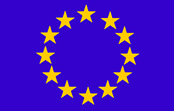
 European UnionHeadquarters: Brussels
Introduction
“A day will come when all nations on our continent will form a European brotherhood… A day will come when we shall see… the United States of America and the United States of Europe face to face, reaching out for each other across the seas.” — Victor Hugo, 1848
The idea of a unified Europe was not new when the European Coal and Steel Community was founded in 1952. But who could have envisioned that Europe, after having been almost totally destroyed by two World Wars, would become one of the foremost economic powers in the world in just fifty short years?
The European Union (EU) is a political and economic union of 27 member states, created by the Maastricht Treaty which entered into force on November 1, 1993. The EU operates a single internal market allowing free movement of goods, capital, services, and people between member states. It has its own parliament, court system, central bank, and diplomatic service. The EU was awarded the Nobel Prize for Peace in 2012 in recognition of its efforts to promote peace and democracy in Europe.
The first six members — Belgium, France, Italy, Luxembourg, the Netherlands, and West Germany — signed the Treaty of Paris in 1951. Since then, the union has expanded through successive waves of enlargement: Denmark, Ireland, and the United Kingdom joined in 1973; Greece in 1981; Spain and Portugal in 1986; Austria, Finland, and Sweden in 1995; ten Central and Eastern European nations plus Cyprus and Malta in 2004 and 2007; and Croatia in 2013. The United Kingdom voted to leave in 2016 and formally departed on January 31, 2020 — the only nation ever to withdraw from the EU.
The European Union has 24 official languages and three working languages (English, French, and German). Despite the UK’s departure, English remains the EU’s most commonly used working language. The EU’s combined GDP makes it one of the two largest economies in the world, competing with the United States and China. Brussels, the de facto EU capital, is home to over 1,000 international organizations and the second-largest diplomatic community in the world after Washington, D.C.
EU Member Countries
The 27 member states of the European Union as of 2026.
 Austria
 Belgium
 Bulgaria
 Croatia
 Cyprus
 Czech Republic
 Denmark
 Estonia
 Finland
 France
 Germany
 Greece
 Hungary
 Ireland
 Italy
Italy Latvia
 Lithuania
 Luxembourg
 Malta
Malta Netherlands
 Poland
 Portugal
 Romania
 Slovakia
 Slovenia
 Spain
Spain Sweden
The Euro
The euro (€) is the official currency of 21 of the 27 EU member states, collectively known as the Eurozone. Introduced as an accounting currency in 1999 and as physical notes and coins in 2002, the euro is the second most traded currency in the world after the U.S. dollar.
The most recent country to adopt the euro is Bulgaria, which joined the Eurozone on January 1, 2026. Croatia joined in 2023. Six EU members do not use the euro: Czech Republic, Denmark (which holds a permanent opt-out), Hungary, Poland, Romania, and Sweden.
Four European microstates — Andorra, Monaco, San Marino, and Vatican City — use the euro through monetary agreements with the EU. Kosovo and Montenegro use the euro unilaterally without EU authorization.
The Schengen Area allows passport-free travel across 29 countries (25 EU members plus Iceland, Liechtenstein, Norway, and Switzerland). Bulgaria and Romania joined the Schengen Area in 2024. Cyprus and Ireland remain outside Schengen.
Candidate Countries
Countries in various stages of the EU accession process as of 2026.
 Albania
 Bosnia & Herzegovina
 Montenegro
 North Macedonia
 Serbia
 Turkey
 Ukraine
 Moldova
Albania was granted candidate status in 2014; accession negotiations opened in 2022. Montenegro has been in negotiations since 2012 and is considered the frontrunner among candidates. North Macedonia has been a candidate since 2005, with negotiations opening in 2022 after resolving its naming dispute with Greece. Serbia has been in negotiations since 2014, though progress depends on normalization of relations with Kosovo.
Turkey has been a candidate since 1999, but accession negotiations have been effectively frozen since 2018 over rule-of-law and human rights concerns. Ukraine and Moldova were granted candidate status in June 2022 following Russia’s invasion of Ukraine, and accession negotiations were formally opened in 2024. Bosnia and Herzegovina was granted candidate status in December 2022. Georgia received candidate status in December 2023, though its accession process has been complicated by domestic political developments. Kosovo has applied for membership but faces challenges due to disputed statehood — five EU members do not recognize Kosovo’s independence.
Other European Countries
European countries that are not EU members or candidates.
 Andorra
 Belarus
 Liechtenstein
 Monaco
 Norway
 Russia
 San Marino
 Switzerland
 Vatican City
Norway, Iceland, and Liechtenstein participate in the EU’s single market through the European Economic Area (EEA) agreement without being EU members. Switzerland has a separate set of bilateral agreements with the EU. All four are members of the Schengen Area.
The United Kingdom left the European Union on January 31, 2020, following a 2016 referendum. The UK-EU Trade and Cooperation Agreement governs the post-Brexit relationship, including trade, security, and fisheries. The UK is no longer part of the single market, the customs union, or the Schengen Area.
Russia & Europe
The Russian Federation emerged from the dissolution of the Soviet Union in 1991. Following the collapse of Communism, the country split into fifteen independent states. The Russian Federation is the largest and most powerful of these successor states.
Several former Soviet states banded together to form the Commonwealth of Independent States (CIS), maintaining ties with Moscow. Others — notably Lithuania, Latvia, and Estonia — turned decisively toward Europe and are now EU and NATO members.
EU-Russia relations have deteriorated profoundly since 2014, when Russia annexed Crimea from Ukraine. Following Russia’s full-scale invasion of Ukraine in February 2022, the EU imposed comprehensive economic sanctions on Russia, including restrictions on energy imports, financial transactions, technology exports, and travel. Russia’s Council of Europe membership was terminated. EU-Russia trade has declined dramatically, and the relationship is at its lowest point since the Cold War.
Business travelers should be aware that operating in Russia now involves significant legal, financial, and reputational risks due to international sanctions. Many Western companies have exited or suspended Russian operations. Consult your government’s sanctions guidance and travel advisories before any Russia-related business activity.
Resources
EU Institutions
- European Union Official WebsitePortal for all EU institutions and policies
- EU Member CountriesInteractive map and country details
- European Central BankMonetary policy and the euro
- European ParliamentLegislative body of the EU
Data & Trade
- EurostatEU statistical data and analysis
- CIA World Factbook — EUDemographics, economy, structure
- EU Trade PolicyTrade agreements and market access
Cultural Framework
- Cyborlink Hofstede ExplainerThe six-dimension model explained
- Hofstede Insights — Country ComparisonCompare any EU nation with another
- Cyborlink Europe Region PageIndividual European country profiles
- Cyborlink Resource PageBooks, world press, language tools